Before the Great Deluge there were those who understood the laws governing heaven and earth. They had inherited the primordial science: astronomy, geometry, alchemy, sacred architecture, the knowledge of the divine order underlying creation. They foresaw what was coming. And they did not let it die with them.
The account preserved by Flavius Josephus in the Antiquities of the Jews (Book I, 2:3) is the oldest surviving written form of the legend. Josephus attributes the preservation of the antediluvian sciences to the children of Seth, son of Adam — a lineage of righteous sages who had systematized the celestial sciences over generations. Knowing that the world would be destroyed — by fire, or by water — they inscribed all their knowledge upon two great columns:
"They also were the inventors of that peculiar sort of wisdom which is concerned with the heavenly bodies and their order. And that their inventions might not be lost before they were sufficiently known, upon Adam's prediction that the world was to be destroyed at one time by the force of fire and at another time by the violence and quantity of water, they made two pillars: the one of brick, the other of stone: they inscribed their discoveries on them both, that in case the pillar of brick should be destroyed by the flood, the pillar of stone might remain, and exhibit those discoveries to mankind; and also inform them that there was another pillar of brick erected by them. Now this remains in the land of Siriad to this day."
- Flavius Josephus, Antiquities of the Jews, I.2.3
Marble — which the waters could not dissolve.
Brick (or brass) — which the fire could not consume.
One enduring the purgation of fire — spirit, revelation.
The other enduring the deluge of water — matter, dissolution.
Together, they embodied the eternal preservation of truth through the elemental cycles of destruction and renewal. That one pillar "remains in the land of Siriad to this day" — understood by ancient commentators as Egypt, the land of the sun, the mythic birthplace of the Hermetic sciences — is significant. The pillars do not vanish with the lost world. They endure into the new age, waiting to be found.
Hermes the Restorer
After the Flood, the sciences were not remembered. The survivors rebuilt from almost nothing. The libraries of the antediluvian world were silent under the waters. The sacred knowledge was gone from human memory — but not from the world. It waited in stone and in brass, in an ancient land, for one who could read it.
That one was Hermes.
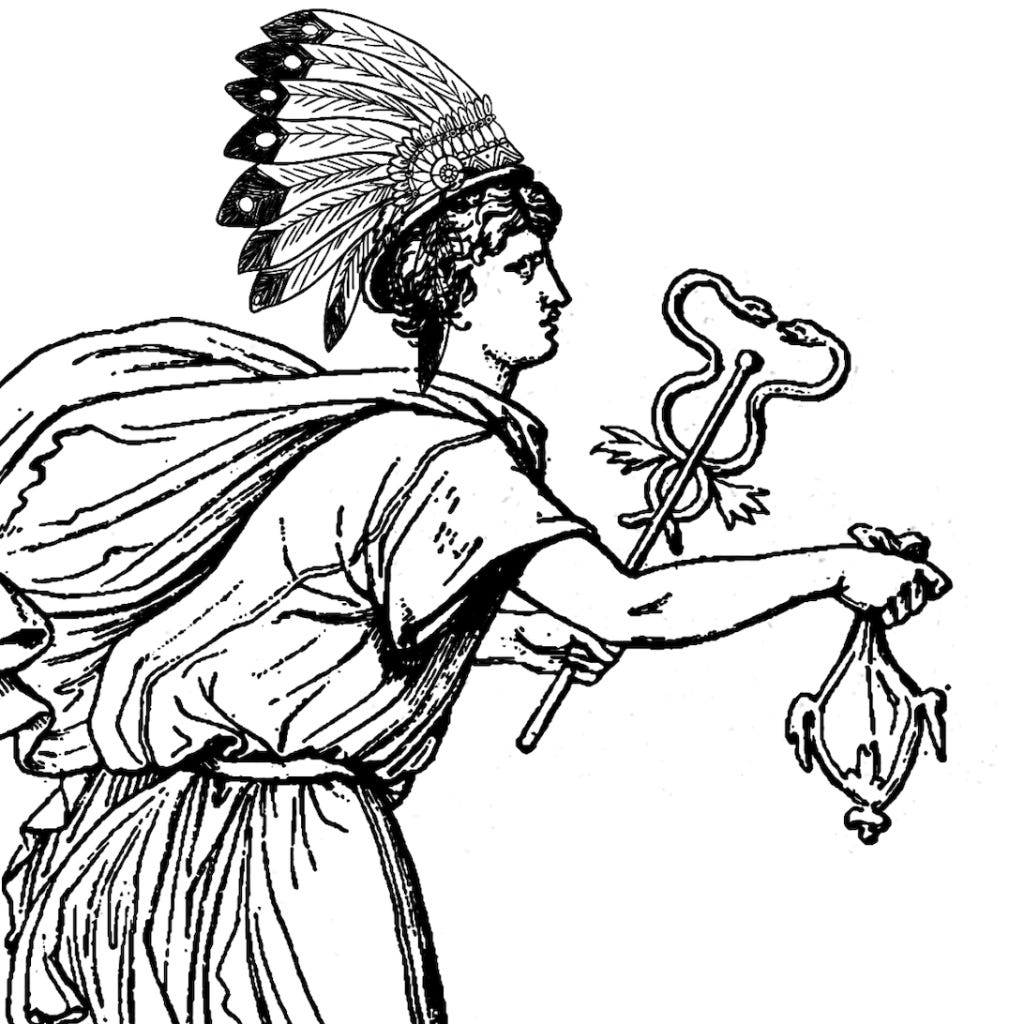
In the Cooke Manuscript (ca. 1390 CE), one of the earliest surviving documents of the Masonic tradition, the legend is set forth: Hermes the philosopher — explicitly identified with Hermes Trismegistus, the thrice-great sage and archetypal revealer of the Hermetic arts — discovered the pillars after the Flood, deciphered the inscriptions, and restored the sciences to humanity. Geometry, astronomy, architecture, and the sacred arts were thus recovered, not invented anew. Hermes did not originate the tradition — he transmitted it. He was the bridge between the world that was and the world that came after.
This is the founding myth of the Hermetic lineage: that the wisdom did not begin with Greece or Egypt, but in the age before the Flood, inscribed by sages who knew what was coming. Hermes simply recovered what had been sealed away. From his rediscovery, the sciences and arts of civilization were rebuilt — and the esoteric current was restored to those who could receive it.
In later Arabic Hermetica, this figure of Hermes the Restorer is developed at length. He is called Hirmis, the first prophet-philosopher. He teaches the sciences of the stars and the stones. He founds the mysteries. He encodes wisdom in temples and inscriptions that will outlast ordinary time. He is, in these traditions, not only the discoverer of the Pillars but their spiritual heir — the living continuation of the Sethite lineage.
Hermes, Enoch, Idrīs — One Sage or Many?
The traditions do not agree on who Hermes was — or whether a single figure underlies the many names.
Enoch — seventh patriarch from Adam in the Hebrew genealogy, "who walked with God and was not, for God took him" (Genesis 5:24) — is, in the Book of Enoch and in Jewish mystical tradition, the archetypal scribe of heaven. He was taken before the Flood. He received the secrets of the angels and the cosmos. He did not die — he was translated. In Kabbalistic and Merkavah mysticism, Enoch becomes Metatron, the highest of the angelic scribes, the one who stands at the threshold of the Divine Presence. He is the pre-diluvian sage par excellence.
In Islamic tradition, Idrīs — named in the Qur'an (Sura 19:56–57) as a prophet who was "raised to a high place" — is widely equated with Enoch in classical Islamic scholarship. But he is also equated with Hermes. The great Islamic philosopher al-Shahrastānī identifies Idrīs-Hermes as the father of philosophy, the first sage who taught the sciences of the stars and sacred letters. In Sufi esoteric tradition, Idrīs-Hermes-Enoch is a single composite figure: the primordial initiate who stands outside ordinary time, the guardian of the celestial mysteries.
Syncretist traditions — particularly in the Neoplatonic and Renaissance Hermetic schools — further collapsed these figures. The Prisca Theologia lineage of Marsilio Ficino and Pico della Mirandola placed Hermes Trismegistus at the very origin of the philosophical and theological tradition, calling him contemporary with Moses, or even earlier. Whether this Hermes is one man or a title — whether the Hermetic corpus reflects the teachings of a single ancient sage or the accumulated wisdom of a school and lineage — remains debated. But what the tradition preserves is a type: the sage who stands at the threshold of two worlds, receives the knowledge of the higher order, and ensures its transmission through catastrophe.
Whether Hermes and Enoch are the same person, or whether they represent two expressions of the same primordial archetype — the great translator of divine knowledge into transmissible form — may matter less than what both figures signify: that there were those who knew, that they gave everything to ensure the knowledge survived, and that it did.
Perhaps there were many such sages across many ages and many traditions. The antediluvian world was vast and old. The memory of multiple great knowers — Enoch, Hermes, Idrīs, Thoth, the Sethite patriarchs — may each be a refraction of an older, deeper truth: that the transmission of sacred knowledge is itself a sacred task, running through human history in an unbroken thread, carried by those who are given to carry it.
The Pillars as Symbol
The two Pillars are more than a narrative device. They are a symbol of something enduring — the conviction that sacred knowledge is indestructible when properly preserved, that the inner laws of creation cannot be annihilated by any outward catastrophe.
The duality of the Pillars resonates across the entire tradition:
- Fire and Water — the two modes of cosmic dissolution. The stone pillar survives the flood; the brick (or brass) pillar survives the fire. Together, they span all destruction.
- Matter and Spirit — two modes of existence, two dimensions of sacred science. The Pillars encode what is necessary for the reconstruction of both inner and outer civilization.
- Two lineages, two paths — some traditions read the two Pillars as representing two great streams of initiatory wisdom: the path of revelation (fire, spirit) and the path of dissolution and reformation (water, matter). In Hermetic terms: the Solar and Lunar streams, the active and the receptive, the Way of Fire and the Way of Water.
- Right hand and left hand — the two aspects of the great Work, surrender and effort, grace and discipline.
In Freemasonry, the myth is architecturalized. The two great Pillars of Boaz and Jachin at the entrance to Solomon's Temple echo this antediluvian symbolism. Every Lodge entrance flanked by twin pillars is, in this reading, a echo of the Hermetic Pillars — the threshold through which the initiate passes from the outer world into the sanctified space where the ancient knowledge is alive. One pillar: In strength. The other: He shall establish. Together: In strength shall He establish — the covenant of the sacred sciences restored.
one enduring the purgation of fire (spirit, revelation), and the other enduring the deluge of water (matter, dissolution). Their dual composition embodies the eternal preservation of truth through the elemental cycles of destruction and renewal.
The Land of Siriad
Josephus notes that one Pillar "remains in the land of Siriad to this day." This enigmatic phrase — land of Siriad — has been interpreted across centuries as a name for Egypt, derived possibly from Sirius, the star identified in Egyptian tradition with Isis and with the flooding of the Nile. Egypt as the land of Sirius: the land where the sacred sciences were recovered, where Hermes walked, where the temples encoded the same geometry that the antediluvian sages had first inscribed in stone.
This connects the Hermetic Pillars directly to the Egyptian temple tradition — to the idea that the great temples of Egypt are themselves, in a sense, pillars of preservation: built in stone to encode sacred knowledge in geometric form, to outlast any catastrophe, to be read by future initiates who have the eyes to see.
The Pyramid, in this reading, is the supreme Pillar of Hermes — the encoded knowledge of the antediluvian world, given physical form that can endure until the next age of recovery.
Within the Royal Art Opus
The story of the Two Pillars of Hermes is not a myth about the past. It is the myth that defines what the Royal Art is and what it is for.
The lineage is named in the Aurea Catena — the Golden Chain of transmission that runs from Adam through Seth and Enoch, through Noah and the Ark, through the Pillars of Hermes, through Abraham and Moses and Solomon's Temple, through the Essenes, through Yeshua, through the Gnostic disciples, the Knights Templar, the Rosicrucian Vault, and the Masonic recovery of the Lost Word — to the present Work. The Pillars of Hermes are not a curiosity at the beginning of this chain. They are its hinge point — the moment at which the primordial knowledge passed through the eye of the needle of a world catastrophe and emerged intact on the other side.
The Royal Art understands itself as the present-day continuation of that same lineage: the knowledge and tradition that was preserved through the Flood, transmitted through the Mystery Schools, veiled in symbols and allegories, encoded in cathedral geometry and alchemical emblems — now being recovered, synthesized, and brought to flower again.
The Work is, in this sense, a fulfillment of the Pillars' purpose. The antediluvian sages did not inscribe their wisdom in stone merely to preserve it as a relic. They preserved it to be used — to flower and bear fruit in an age that was ready to receive it. The Pillars were not a tomb. They were a seed vault.
Whatever was lost or hidden in the ages of forgetting — the full science of transformation, the initiatory current, the knowledge of the inner architecture of the soul — can be restored and remembered. The Royal Art is the attempt at that restoration: not invention, but recovery; not a new religion, but the remembrance of the oldest one.
The Hermetic Restorer is, in this light, an archetypal role — not only what Hermes did once, long ago, but what every initiate does when they take up the Work. To discover the Pillars, to read what is inscribed, to transmit what was preserved: this is the continuity of the lineage itself. The initiate is always, in some sense, Hermes finding the Pillars again.
“And in the period of time from Adam to the flood, they relate that the ancients had discovered two pillars: one of brick and the other of stone. They inscribed their discoveries on them in order that if the brick pillar was destroyed by the flood, the stone would remain; and if the stone were destroyed by fire, the brick might remain and reveal their discoveries to men.” - Clement of Alexandria: Stromata (William Wilson translation)
“They also made two pillars, one of brick, the other of stone: they inscribed their discoveries on them, that in case the pillar of brick should be destroyed by the flood, the pillar of stone might remain, and exhibit those discoveries to mankind; and also inform them that there was another pillar of brick erected by them.” - Josephus: Antiquities of the Jews (Book 1, Chapter 2) William Whiston (1737)
Earlier than Josephus, we find the motif of preserving knowledge in the event of an impending flood in 1st Enoch, a Jewish apocalyptic text supposed to have been compiled by various authors beginning in the 3rd century BCE. While 1st Enoch doesn’t mention two pillars, it does have an angel, probably Uriel, showing Enoch heavenly tablets and instructing him to read and remember every detail. Enoch then records what he learned from the tablets in books and gives these to his son Methuselah, saying:
“Preserve, my son Methuselah, the books from thy father’s hand, and (see) that thou deliver them to the generations of the world.” - 1 Enoch 82:1”
- Excerpt From:
Excerpt From:
After the Regius in age and importance, we have the Cooke Manuscript, dated around 1490. Plenty stands out about its specific legend, moral reinforcement, and attempt to retrace Masonic origins. At one point the author recounts the tale of the first blacksmith, Tubal Cain, mentioned in Genesis as “the forger of all instruments bronze and iron.” (Genesis 4:22)
As the Cooke MS reads:
“Ye shall understand that this son Tubal Cain was [the] founder of smiths’ craft, and of other crafts of metal, that is to say, of iron, of brass, of gold, and of silver…”
Tubal Cain with others prophesied God’s plan to take vengeance on Mankind for their sins. But whether or not it came by way of fire or water, they knew they must devise a way to “save the sciences that they [had] found . . .” After taking counsel, they turned to two stones in which to inscribe their sciences for posterity, should all that mankind had built and knew be lost to a catastrophe. Thus the wise Jabal, most cunning in science, inscribed “in the II pillars all the science[s], and crafts . . .”
“And after this flood many years, as the chronicle telleth, these II pillars were found, and as the Pilicronicon saith, that a great clerk that [was] called Pythagoras found that one, and Hermes, the philosopher, found that other, and they taught forth the sciences that they found therein written.”
So it was that Pythagoras and Hermes entered the Masonic tradition. Hermes was at once “the philosopher” or “father of wise men,” and Pythagoras is depicted an early inheritor of ancient wisdom. ….
Iamblichus, the late Hermetic and Neoplatonist writer of a biography of Pythagoras, had many centuries earlier referred to the pillars of Hermes as a source for Pythagoras’s wisdom:
“If also you should propose any philosophic inquiry, we shall discuss it for you, according to the ancient pillars of Hermes, which Plato and Pythagoras knew before, and from thence constituted their philosophy.” - Iamblichus (242 to 325 AD)
Library of Light Edition 1.0 — Last revised: March 2026