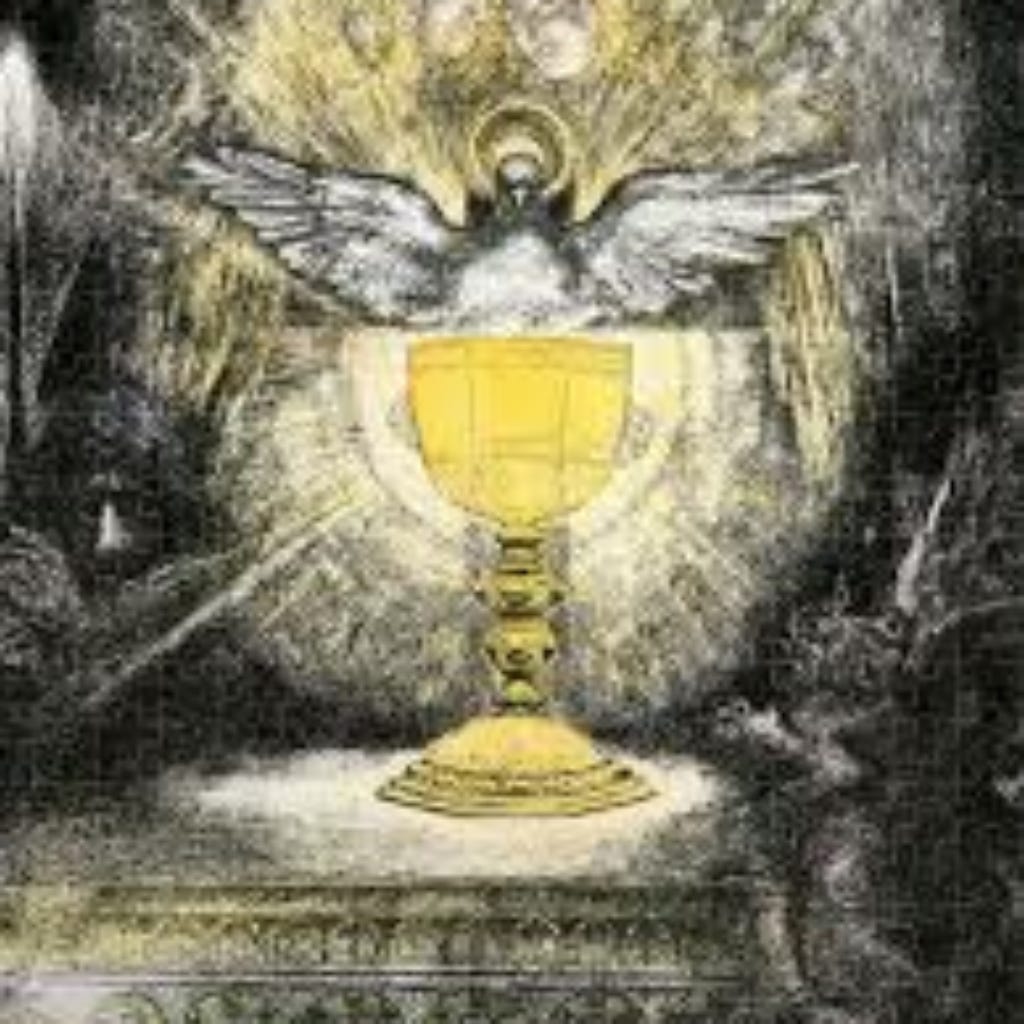
“The Celtic priestly caste, the Druids, resembled the Indo-Aryan Ṛṣis and Brahmins in their oral transmission of sacred knowledge. When Christianity entered this world, accompanied by the legend of Christ’s Grail at the Last Supper and the Crucifixion, the older current was not displaced. Instead, the Grail mystery was renewed within the Celtic Church, creating a living bridge between the Christian revelation and the Hyperborean memory.” -
Tuatha de Danaan
At this point of the unfolding of the Irish legend, an attempt at heroic restoration occurs. It is the cycle of the Tuatha de Danaan, a name that means “the people of the goddess Anu or Dane.” This race, on the one hand, is believed to have come to Ireland from “heaven” — hence, according to the Leabhar na h-uidhre (Book of the Dun Cow), “their wisdom and sublimity of their knowledge.” On the other hand, they are believed to have acquired a supernatural knowledge in the Hyperborean region. These two versions do not contradict each other, but rather shed light on each other, owing both to the more-than-human character of the primordial center, and to the fact that, according to the legend, the race of the Tuatha derived from surviving members of the Neimheidh race. These survivors allegedly traveled to the Hyperborean or Western-Atlantic land in order to acquire supernatural knowledge, which explains a relationship with certain mystical objects, more on which later. - Julius Evola, Mystery of the Grail
Library of Light Edition 1.0 — Last revised: March 2026