Arithmologia, sive De Abditis Numerorum Mysteriis is a 1665 work by the Jesuit scholar Athanasius Kircher
This book is the only one of Kircher's works devoted entirely to different aspects of number symbolism, exploring numbers as the underlying principle and structure of the universe and as the key to mystic understanding previously revealed to patriarchs and philosophers in ancient times.
It combines religious mysticism with mathematics, and Kircher did not accept the mysticism uncritically, often discrediting common superstitions about numbers.

Born on May 2, 1602, in Geisa, a modest town in the Holy Roman Empire's Fulda region, Athanasius Kircher entered a world teetering between the Renaissance's humanistic rebirth and the Baroque era's turbulent fusions of faith and reason. Orphaned early and raised amid the Thirty Years' War's chaos (1618–1648), which ravaged Europe with religious strife, Kircher sought refuge in the Jesuit Order, joining in 1618 at Paderborn. The Jesuits, those scholarly warriors of the Counter-Reformation, provided him a rigorous education in philosophy, theology, mathematics, and languages—Hebrew, Syriac, Arabic, and more—equipping him as a polymath whose curiosity spanned the visible and invisible realms. His early travels, including a perilous journey through war-torn Germany and a brief stint in Malta (1637), exposed him to diverse cultures, fostering a syncretic worldview that blended Christian orthodoxy with pagan and Eastern mysteries. By 1638, he settled in Rome at the Collegio Romano, where he curated the Kircherianum museum—a cabinet of curiosities filled with automata, magnetic devices, and exotic artifacts symbolizing the universe's hidden mechanisms.
Kircher's life (d. November 28, 1680) was a testament to the alchemical principle of solve et coagula—dissolving boundaries between disciplines to coagulate new syntheses—producing over 40 volumes that, while sometimes erroneous by modern standards, pulsed with the vitality of esoteric inquiry.
Kircher's plunge into the occult depths began with his fascination for the Prisca Theologia, that ancient theology posited by Renaissance hermeticists like Marsilio Ficino and Pico della Mirandola as a primordial wisdom revealed to humanity in antiquity and preserved through Egyptian, Chaldean, Hebrew, and Greek traditions.
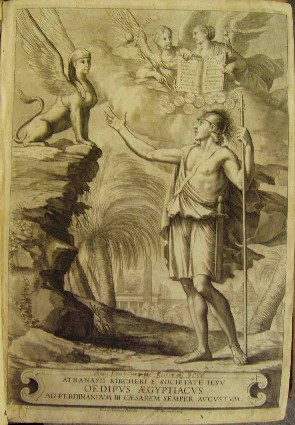
In his magnum opus, Oedipus Aegyptiacus (1652–1654), Kircher positioned himself as the "Egyptian Oedipus," unraveling the riddles of hieroglyphs not as phonetic script but as symbolic ideograms encoding divine truths. Drawing from the Corpus Hermeticum—texts attributed to Hermes Trismegistus, whom Kircher equated with Moses—he argued that Egyptian inscriptions were a "sacred writing" veiling metaphysical secrets, a language of the gods where each mark resonated with cosmic harmonies.
This interpretation, though flawed (hieroglyphs were later decoded as phonetic by Champollion in 1822), was groundbreaking in occult terms: it revived the notion of Egypt as the cradle of esoteric wisdom, influencing later mystics who saw hieroglyphs as talismanic keys to invocation and manifestation. For Kircher, hieroglyphs were not mere relics but living symbols, akin to alchemical emblems or Kabbalistic letters, capable of unlocking the anima mundi—the world soul. This contributed to the occult tradition by reinforcing the idea of "correspondences," where symbols bridge the microcosm (human soul) and macrocosm (universe), a principle central to high magic and later systems like those of Eliphas Lévi or the Golden Dawn.
In the realm of magic, Kircher's Musurgia Universalis sive Ars Magna Consoni et Dissoni (1650) stands as a symphony of esoteric thought, where music transcends auditory pleasure to become a form of natural magic. He posited a "universal harmony" governing all creation, inspired by Pythagorean numerology and Platonic ideals, where sound vibrations mirror the proportions of the cosmos. Kircher described musical instruments as microcosmic replicas of divine order—his "catacoustic" experiments with hidden tubes to amplify sounds evoked sympathetic magic, where like attracts like. This work delved into "artificial magic," distinguishing it from demonic sorcery: for Kircher, magic was the art of harnessing hidden natural forces, such as magnetism or acoustics, to reveal God's design. His illustrations of "musical automata"—water-powered organs playing eternal hymns—symbolized the perpetual motion of the alchemical opus, influencing Rosicrucian concepts of the "chemical wedding" as harmonious union. Esoterically, Kircher's music theory prefigured vibrational magic, where incantations (like Enochian calls in Dee's system) align the practitioner with celestial spheres, a thread woven into modern occult practices like sound healing or mantra-based evocation. By framing magic as "scientific," Kircher sanitized it for Christian audiences, yet preserved its occult essence, contributing to the tradition's survival amid Inquisition fears.
Kircher's alchemical explorations, particularly in Mundus Subterraneus (1665), plunged into the earth's hidden depths as a metaphor for the soul's descent into matter. Descending into Mount Vesuvius's crater in 1638—a daring act he likened to Orpheus's katabasis—Kircher envisioned the planet as a living organism, with central fires as an alchemical furnace transmuting elements through subterranean channels. Volcanoes were "safety valves" for this inner heat, echoing Paracelsian ideas of macrocosmic-microcosmic correspondence.
He speculated on "panspermia"—universal seeds disseminated through cosmic winds—prefiguring modern panspermia theories but rooted in alchemical vitalism, where life emerges from prima materia. This work integrated alchemy with geology, viewing transmutation not just as laboratory art but as natural process, influencing occultists like Blavatsky, who saw earth's "subterranean" realms as astral planes for soul evolution. Kircher's maps of Atlantis (submerged by divine wrath) symbolized lost esoteric paradises, linking to Grail myths of hidden sanctuaries.
Kircher's engagement with Kabbalah, though filtered through Christian lenses, deepened the occult tradition's syncretism. Influenced by Johannes Reuchlin's De Arte Cabbalistica (1517) and Agrippa's De Occulta Philosophia (1533), he viewed Kabbalah as a Hebrew echo of Egyptian Hermeticism. In Oedipus Aegyptiacus, he analyzed the Tree of Life as a cosmic diagram, with sephirot as emanations mirroring hieroglyphic symbols. Numbers and letters were divine archetypes, tools for combinatory arts akin to Ramon Llull's Ars Magna—systems for generating truths through permutation, which Kircher applied to linguistics and cryptography. This Kabbalistic combinatorics influenced his "universal language" projects, envisioning a symbolic system to restore pre-Babel unity—a magical operation for divine communion.
Central to Kircher's occult legacy is his treatment of the Shemhamphorash—the 72-fold Name of God derived from Exodus 14:19–21, a Kabbalistic construct of angelic names formed by permuting Hebrew letters. In Oedipus Aegyptiacus, Kircher dissected it as a mystical formula, linking it to Egyptian amulets and Chaldean oracles. He saw the Shem as a theurgic key: each tri-literal name (e.g., Vehuiah) invokes an angel, channeling divine attributes for protection, prophecy, or transformation. Drawing from Pico and Reuchlin, Kircher framed it within Christian Kabbalah, cautioning against misuse but affirming its power in high magic—operations where the adept, through vocalization and meditation, aligns with celestial hierarchies.
The "Shem operation," as Kircher conceptualized, involved ritual permutation: arranging names in circles or talismans, intoning them to evoke angels—balancing Goetic demons in grimoires like the Lesser Key of Solomon. This resonated with Agrippa's angelic magic and influenced later occultists: Thomas Rudd integrated it into Solomonic evocations, while Golden Dawn adepts used it for invocation circles. Kircher's approach—scientific yet mystical—sanitized Kabbalah for Catholic audiences, preserving its esoteric core amid heresy fears.
Kircher's broader contributions to occultism lie in his universalism: in China Illustrata (1667), he traced global myths to Noah's descendants, syncretizing Chinese, Egyptian, and Biblical lore—a Prisca Theologia model that inspired Theosophy's ancient wisdom races. His Arithmologia (1665) treated numbers as divine emanations, echoing Pythagorean-Kabbalistic numerology, while Latium (1671) explored Etruscan mysticism as proto-Hermetic. Though a Jesuit, Kircher navigated censorship by framing esotericism as "natural theology," yet his works brimmed with magical implications: magnetic "sympathies" as love spells, optical illusions as illusions of maya.
His legacy reverberates through occult history: Leibniz praised his combinatorics, Newton studied his optics (with alchemical undertones), and Romantic occultists like Poe drew from his "misconceptions" for atmospheric mysticism. In Rosicrucianism, Kircher's harmonies informed Fludd's monochord; Freemasons echoed his sacred architecture; Blavatsky cited him in Isis Unveiled for Egyptian links. Modern chaos magicians adapt his "panspermia" as probability manipulation, while his Shem analyses underpin angelic evocation in Crowley's Thelema. Kircher's errors—e.g., hieroglyph misreadings—paradoxically fueled occult creativity, proving that in the Great Work, imagination transmutes imperfection into insight.

'/%3E%3Cpath d='M16.0001 7.9996c0 4.418-3.5815 7.9996-7.9995 7.9996S.001 12.4176.001 7.9996 3.5825 0 8.0006 0C12.4186 0 16 3.5815 16 7.9996Z' fill='url(%23paint1_radial_15251_63610)'/%3E%3Cpath d='M16.0001 7.9996c0 4.418-3.5815 7.9996-7.9995 7.9996S.001 12.4176.001 7.9996 3.5825 0 8.0006 0C12.4186 0 16 3.5815 16 7.9996Z' fill='url(%23paint2_radial_15251_63610)' fill-opacity='.5'/%3E%3Cpath d='M7.3014 3.8662a.6974.6974 0 0 1 .6974-.6977c.6742 0 1.2207.5465 1.2207 1.2206v1.7464a.101.101 0 0 0 .101.101h1.7953c.992 0 1.7232.9273 1.4917 1.892l-.4572 1.9047a2.301 2.301 0 0 1-2.2374 1.764H6.9185a.5752.5752 0 0 1-.5752-.5752V7.7384c0-.4168.097-.8278.2834-1.2005l.2856-.5712a3.6878 3.6878 0 0 0 .3893-1.6509l-.0002-.4496ZM4.367 7a.767.767 0 0 0-.7669.767v3.2598a.767.767 0 0 0 .767.767h.767a.3835.3835 0 0 0 .3835-.3835V7.3835A.3835.3835 0 0 0 5.134 7h-.767Z' fill='%23fff'/%3E%3Cdefs%3E%3CradialGradient id='paint1_radial_15251_63610' cx='0' cy='0' r='1' gradientUnits='userSpaceOnUse' gradientTransform='rotate(90 .0005 8) scale(7.99958)'%3E%3Cstop offset='.5618' stop-color='%230866FF' stop-opacity='0'/%3E%3Cstop offset='1' stop-color='%230866FF' stop-opacity='.1'/%3E%3C/radialGradient%3E%3CradialGradient id='paint2_radial_15251_63610' cx='0' cy='0' r='1' gradientUnits='userSpaceOnUse' gradientTransform='rotate(45 -4.5257 10.9237) scale(10.1818)'%3E%3Cstop offset='.3143' stop-color='%2302ADFC'/%3E%3Cstop offset='1' stop-color='%2302ADFC' stop-opacity='0'/%3E%3C/radialGradient%3E%3ClinearGradient id='paint0_linear_15251_63610' x1='2.3989' y1='2.3999' x2='13.5983' y2='13.5993' gradientUnits='userSpaceOnUse'%3E%3Cstop stop-color='%2302ADFC'/%3E%3Cstop offset='.5' stop-color='%230866FF'/%3E%3Cstop offset='1' stop-color='%232B7EFF'/%3E%3C/linearGradient%3E%3C/defs%3E%3C/svg%3E)
'%3E%3Cpath d='M15.9963 8c0 4.4179-3.5811 7.9993-7.9986 7.9993-4.4176 0-7.9987-3.5814-7.9987-7.9992 0-4.4179 3.5811-7.9992 7.9987-7.9992 4.4175 0 7.9986 3.5813 7.9986 7.9992Z' fill='url(%23paint0_linear_15251_63610)'/%3E%3Cpath d='M15.9973 7.9992c0 4.4178-3.5811 7.9992-7.9987 7.9992C3.5811 15.9984 0 12.417 0 7.9992S3.5811 0 7.9986 0c4.4176 0 7.9987 3.5814 7.9987 7.9992Z' fill='url(%23paint1_radial_15251_63610)'/%3E%3Cpath d='M7.9996 5.9081c-.3528-.8845-1.1936-1.507-2.1748-1.507-1.4323 0-2.4254 1.328-2.4254 2.6797 0 2.2718 2.3938 4.0094 4.0816 5.1589.3168.2157.7205.2157 1.0373 0 1.6878-1.1495 4.0815-2.8871 4.0815-5.159 0-1.3517-.993-2.6796-2.4254-2.6796-.9811 0-1.822.6225-2.1748 1.507Z' fill='%23fff'/%3E%3C/g%3E%3Cdefs%3E%3CradialGradient id='paint1_radial_15251_63610' cx='0' cy='0' r='1' gradientUnits='userSpaceOnUse' gradientTransform='matrix(0 7.9992 -7.99863 0 7.9986 7.9992)'%3E%3Cstop offset='.5637' stop-color='%23E11731' stop-opacity='0'/%3E%3Cstop offset='1' stop-color='%23E11731' stop-opacity='.1'/%3E%3C/radialGradient%3E%3ClinearGradient id='paint0_linear_15251_63610' x1='2.3986' y1='2.4007' x2='13.5975' y2='13.5993' gradientUnits='userSpaceOnUse'%3E%3Cstop stop-color='%23FF74AE'/%3E%3Cstop offset='.5001' stop-color='%23FA2E3E'/%3E%3Cstop offset='1' stop-color='%23FF5758'/%3E%3C/linearGradient%3E%3CclipPath id='clip0_15251_63610'%3E%3Cpath fill='%23fff' d='M-.001.0009h15.9992v15.9984H-.001z'/%3E%3C/clipPath%3E%3C/defs%3E%3C/svg%3E)
'%3E%3Cpath d='M15.9972 7.9996c0 4.418-3.5815 7.9996-7.9996 7.9996-4.418 0-7.9996-3.5816-7.9996-7.9996S3.5796 0 7.9976 0c4.4181 0 7.9996 3.5815 7.9996 7.9996Z' fill='url(%23paint0_linear_15251_63610)'/%3E%3Cpath d='M15.9973 7.9992c0 4.4178-3.5811 7.9992-7.9987 7.9992C3.5811 15.9984 0 12.417 0 7.9992S3.5811 0 7.9986 0c4.4176 0 7.9987 3.5814 7.9987 7.9992Z' fill='url(%23paint1_radial_15251_63610)'/%3E%3Cpath d='M15.9972 7.9996c0 4.418-3.5815 7.9996-7.9996 7.9996-4.418 0-7.9996-3.5816-7.9996-7.9996S3.5796 0 7.9976 0c4.4181 0 7.9996 3.5815 7.9996 7.9996Z' fill='url(%23paint2_radial_15251_63610)' fill-opacity='.8'/%3E%3Cpath fill-rule='evenodd' clip-rule='evenodd' d='M5.6144 10.8866c.159-1.8461 1.127-2.887 2.382-2.887 1.2551 0 2.2231 1.0418 2.3822 2.887.1591 1.8461-.7342 3.1127-2.3821 3.1127-1.648 0-2.5412-1.2666-2.3821-3.1127Z' fill='%234B280E'/%3E%3Cellipse cx='11.1978' cy='5.6997' rx='1.3999' ry='1.6999' fill='%231C1C1D'/%3E%3Cellipse cx='4.7979' cy='5.6997' rx='1.3999' ry='1.6999' fill='%231C1C1D'/%3E%3Cpath fill-rule='evenodd' clip-rule='evenodd' d='M12.3528 3.166a1.4744 1.4744 0 0 0-1.8591-.3279.4.4 0 1 1-.3976-.6941c.9527-.5457 2.1592-.333 2.8678.5056a.4.4 0 0 1-.6111.5163ZM5.4998 2.8381a1.4744 1.4744 0 0 0-1.859.3278.4.4 0 0 1-.6111-.5162c.7085-.8387 1.915-1.0514 2.8677-.5057a.4.4 0 0 1-.3976.6941Z' fill='%23E0761A'/%3E%3C/g%3E%3Cdefs%3E%3CradialGradient id='paint1_radial_15251_63610' cx='0' cy='0' r='1' gradientUnits='userSpaceOnUse' gradientTransform='matrix(0 7.9992 -7.99863 0 7.9986 7.9992)'%3E%3Cstop offset='.5637' stop-color='%23FF5758' stop-opacity='0'/%3E%3Cstop offset='1' stop-color='%23FF5758' stop-opacity='.1'/%3E%3C/radialGradient%3E%3CradialGradient id='paint2_radial_15251_63610' cx='0' cy='0' r='1' gradientUnits='userSpaceOnUse' gradientTransform='rotate(45 -4.5262 10.9226) scale(10.1818)'%3E%3Cstop stop-color='%23FFF287'/%3E%3Cstop offset='1' stop-color='%23FFF287' stop-opacity='0'/%3E%3C/radialGradient%3E%3ClinearGradient id='paint0_linear_15251_63610' x1='2.3979' y1='2.3999' x2='13.5973' y2='13.5993' gradientUnits='userSpaceOnUse'%3E%3Cstop stop-color='%23FFF287'/%3E%3Cstop offset='1' stop-color='%23F68628'/%3E%3C/linearGradient%3E%3CclipPath id='clip0_15251_63610'%3E%3Cpath fill='%23fff' d='M-.002 0h15.9992v15.9992H-.002z'/%3E%3C/clipPath%3E%3C/defs%3E%3C/svg%3E)
Writings of Athanasius Kircher: From Oedipus Aegyptiacus (1652-4)
Zodiaci veteris (Tome 2, p. 160)

The Goddess: Her Names and Symbols


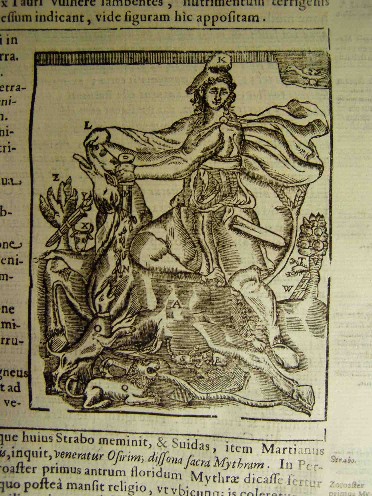


Athanasii Kircheri, Soc. Iesu, Oedipi Aegyptiaci Tomus Secundus,
by Kircher, Athanasius, c. 1653
"Just as in the greater world there is one universal mind which, diffused through all things, gives life to all things; so likewise the lesser world, which we call man, is governed by a rational soul, through whose circulation and motion all the parts are mutually bound together and preserved. From this it comes to pass that the machine of the world, composed of connected bodies, is moved in a unique manner by nature itself, while man, as a lesser world, contains within himself the image of the greater.
Thus the ancient Egyptians, following this analogy, devised their sacred philosophy and theology, in which they represented the hidden operations of nature through symbols and hieroglyphic figures. For they believed that the supreme mysteries of divine and natural things could not be suitably expressed by words alone, but rather by images, figures, and symbolic forms, which speak directly to the intellect.
Therefore nothing was considered more sacred among them than this symbolic doctrine, through which they transmitted the secrets of the universe, the powers of the heavens, and the hidden laws of nature, under the veil of sacred images."
"The science of magic is indeed the most perfect reasoning concerning the powers of nature, by which marvelous effects are produced through a profound understanding of natural causes. This science, although misunderstood by many, was held in the highest esteem by the Egyptians, who referred all inferior causes to superior ones and recognized in the visible world the traces of the invisible.
For they believed that the material world is governed by spiritual principles, and that divine power descends through successive degrees into natural forms. Thus, through hieroglyphs and sacred symbols, they expressed not only physical things but also metaphysical and divine truths, which the Arabs later preserved in their writings on images and talismans."
"“Thus the hieroglyphic system is exceedingly elegant and profound, since it teaches that intellect is to be purified and elevated through proportion, distinctions, exact numbers, measured times, various qualities and virtues, effects, effluences, and harmonious concords. For in this way philosophy, adorned with symbolic veils, was accustomed to conceal its sacred mysteries, and to represent the arcana of the universe under the likeness of visible things. Hence it comes about that divine wisdom appears to the wise as richly abundant, while to the profane and unprepared it remains obscure and inaccessible.”
“By this method, the mind is gradually led from visible things to invisible ones, and from material forms to intellectual essences. Thus the human intellect, illuminated by these symbols, is strengthened, elevated, and rendered capable of grasping the most profound truths. For no science can be perfect unless it comprehends the harmony of the whole, and understands how inferior things depend upon superior causes.”
“For this reason the Egyptians, who flourished in the most ancient times, taught that the human mind itself is a living image of the universe, and that through the contemplation of sacred symbols it may ascend from multiplicity to unity. Hence nothing is more effective in forming the intellect than this symbolic discipline, which penetrates beyond words and leads directly to understanding.”
“Therefore, when the Kabballists pronounce the sacred name Hammephoras [Shem ha-Mephorash], they understand by it not a mere sound, but the unfolding of divine power through ordered emanations. And for this reason the Arabs, following the Egyptians, preserved these doctrines concerning images, seals, and talismans, in which divine names operate through natural and celestial intermediaries.”
“Thus hieroglyphs are not simple signs, but living forms of wisdom, in which theology, philosophy, and natural science are united. Whoever understands them possesses the key to the hidden structure of the worlds.”