“Have you not heard that our native Hermes of Egypt divided the world into tracts and divisions, that he measured the country with a sting, made ditches and canals, made laws, named provinces, set up contracts and agreements, re-discovered the calendar of the rising of the stars, and handed down certain crops, numbers, and calculations, geometry, astrology, astronomy, and music, and, finally, the whole system of grammar which he himself invented?” - Cyril of Alexandria (376 - 444 AD)
Hermes in the Masonic Imagination
The relation between Hermes and Freemasonry belongs chiefly to the symbolic, legendary, and esoteric history of the Craft. Medieval and early modern Masonic writers repeatedly sought venerable origins for the building art: Solomon, Egypt, Euclid, Pythagoras, Noah, the antediluvian patriarchs, and the ancient sciences. Hermes appears within this broad genealogy as philosopher, lawgiver, master of letters and number, and guardian of hidden knowledge.
The Three Faces of Hermes
The name Hermes gathers several traditions that later writers often treated as one. Hermes is the Greek god of mediation, speech, writing, exchange, and passage between worlds. Thoth is the Egyptian divine scribe, master of sacred writing, measure, calculation, ritual knowledge, and the ordering of time. Hermes Trismegistus is the Hellenistic sage figure formed through the identification of Hermes and Thoth, traditionally associated with the Hermetic writings and with ancient Egyptian wisdom. For Masonic and Renaissance readers, these distinctions were often blurred. This blending made Hermes an especially fitting emblem for a fraternity concerned with the liberal arts, sacred architecture, symbolic language, and the transmission of knowledge from master to apprentice.
The Old Charges and the Preservation of the Sciences
The medieval Old Charges are among the earliest surviving documents of the English Masonic tradition. The Regius Poem, composed around the late fourteenth century, combines moral instruction for masons with a legendary history of geometry and the Craft. It reaches back to Egypt, Euclid, and ancient learning, establishing the pattern by which Masonry would remember itself as an heir to venerable sciences. The Cooke Manuscript, from the early fifteenth century, gives Hermes a more explicit place. In its narrative, the arts and sciences are preserved against the destruction of the world through inscribed pillars. After the Flood, Pythagoras discovers one pillar and Hermes “the philosopher” discovers the other; what they recover is then taught anew. The passage does not establish an historical fact about Hermes. Its importance lies in the mythic function it gives him: Hermes becomes a recoverer and transmitter of wisdom that had survived catastrophe. The story gathers several older streams. Josephus tells how the descendants of Seth inscribed their discoveries on pillars of stone and brick so that knowledge might endure through fire or flood. Clement of Alexandria also preserves a version of the two-pillar tradition. Late antique and medieval writers associated Hermes or Mercury with writing, music, calculation, law, astronomy, and the arts. The Masonic legend joins these motifs into a single drama: the sciences are threatened, concealed, found again, and passed onward.
Pillars, Archives, and the Antediluvian Memory
The pillar is one of the deepest symbols in Masonic thought. It is architectural, but it is also a vessel of remembrance. A pillar bears weight, marks a threshold, and preserves an inscription. In the Old Charges, it becomes the archive of a world lost to the Flood. This image resonates with the wider Hermetic and esoteric imagination. Hermetic wisdom is frequently imagined as ancient, veiled, and recovered only by those prepared to read its signs. The antediluvian archive, the tablets of wisdom, the hidden vault, and the inscribed pillar all express the same archetype: truth may be obscured by time and disaster, but it is not wholly destroyed. Within the Masonic temple-symbolism of the lost and recovered word, Hermes therefore stands naturally beside Enoch, the pillars, the sacred vault, and the building of the Temple. He is not simply a person from a remote past. He names the intelligence that receives, records, interprets, and transmits the sciences.
Hermes and the Liberal Arts
The medieval Craft honored geometry as the ordering art of building, proportion, and practical wisdom. The wider Masonic tradition also emphasized the seven liberal arts and sciences: grammar, rhetoric, logic, arithmetic, geometry, music, and astronomy. Hermes could be received as a patronal figure for this entire constellation. As divine messenger, Hermes belongs to language, rhetoric, and mediation. As Thoth, he belongs to writing, measurement, calculation, and sacred record. As Hermes Trismegistus, he belongs to cosmology, astral science, natural philosophy, and the Hermetic art. In this symbolic synthesis, the Masonic labor of building becomes more than a trade. It becomes a discipline of forming the human mind through number, proportion, speech, moral law, and contemplation of the cosmos.
Hermes Trismegistus and Speculative Masonry
The Hermetic writings became newly influential in Europe after the fifteenth-century recovery and translation of the Corpus Hermeticum. By the seventeenth century, Hermetic philosophy, alchemy, astrology, natural magic, biblical chronology, and ancient wisdom traditions were deeply interwoven in many learned circles. Elias Ashmole is an important figure at this threshold. Initiated into Masonry in 1646, he was also a devoted student of alchemy, antiquarian learning, and Hermetic philosophy. His career does not prove that early Freemasonry was itself a Hermetic society. It does show that speculative Masonry arose in a cultural world where Masonic, alchemical, Rosicrucian, and antiquarian interests could meet within the same learned person. In some eighteenth-century high-degree and alchemical Masonic materials, Hermes Trismegistus appears openly among the masters of the Hermetic art. Such references present him as an authority of transmutation, veiled doctrine, and the search for the hidden principles of nature. Hermes thereby becomes one of the symbolic ancestors through whom the Craft could understand its own work as both moral building and inner transformation.
Ramsay and the Ancient Mysteries
Andrew Michael Ramsay’s Masonic oration of 1736–37 gave a powerful new expression to the Craft’s mythic universal history. Ramsay linked Masonic ideals to chivalric and Crusader themes, while also invoking the ancient mysteries of Egypt, Greece, and the wider classical world. His language helped establish a pattern that later high-degree systems would develop: Masonry could be understood as a modern vessel containing fragments of an older initiatory wisdom. Ramsay’s writings also show how Hermes could be imagined as a founder or restorer of Egyptian sacred knowledge. This is not evidence for a direct historical succession from Hermetic Egypt to the lodge. It reveals an eighteenth-century desire to connect moral fraternity, religious universality, ancient mystery, and the recovery of lost truth. Hermes became a natural figure within that desire because he already represented the wise priest, philosopher, interpreter of nature, and keeper of sacred symbols.
The Hermetic Character of Masonic Symbolism
Hermes is present in Masonry most deeply as a pattern of thought rather than as a single official doctrine. Several Masonic themes carry a distinctly Hermetic resonance: Correspondence — the visible temple reflects an invisible order; outer building and inner formation answer one another. Sacred measure — geometry, number, proportion, and architecture disclose intelligible harmony. Veiling and revelation — truth is guarded through symbol, allegory, and graded instruction until the mind is prepared to receive it. Transmission — wisdom passes through masters, books, signs, tools, pillars, and ritual forms rather than appearing as private invention. The work of transformation — roughness is refined, disorder is brought into measure, and the human being becomes fit for a more luminous habitation. These motifs do not make Freemasonry identical with Hermeticism. They show why Hermetic language and figures could be adopted so readily by Masonic writers, artists, ritualists, and esoteric interpreters.
Hermes on the Threshold
The staff of the deacon, sometimes ornamented with a caduceus or Mercurial image, gives a small but revealing emblem of Hermes within lodge symbolism. The deacon moves between stations, bears messages, attends the movement of the lodge, and assists in the ordered communication of ritual. Hermes is likewise the guide across boundaries: between speech and silence, above and below, sacred and ordinary, hidden wisdom and its responsible transmission. For the Royal Art, Hermes may be understood as a companion of the Temple-builder and the seeker of the Lost Word. He guards no merely private secret. He represents the disciplined recovery of the sciences, the reading of the world as symbol, and the patient work by which ancient wisdom is made living again.
the Cooke MS explicitly mentions Isidore of Seville’s Etymologiae. A kind of early encyclopedia that specifically mentions the law-giver Hermes Trismegistus, Mercury, and Hermes the Greek deity.
“Mercury (i.e. Hermes) Trimegistus first gave laws to the Egyptians”
Elsewhere in the Etymologiae it is said that Mercury first contrived strings, first plucked sound from them, and that:
“Mercury (Mercurius) is translated as “speech,” for Mercury is said to be named as if the word were medius currens (“go-between”), because speech is the gobetween for people.”“ . . . on account of his power and knowledge of many arts he is called Trimegistus (i.e. Trismegistus), that is, thrice great (ter maximus). And they imagine him with a dog’s head, they say, because among all animals the dog is held to be the most intelligent and acute species.”
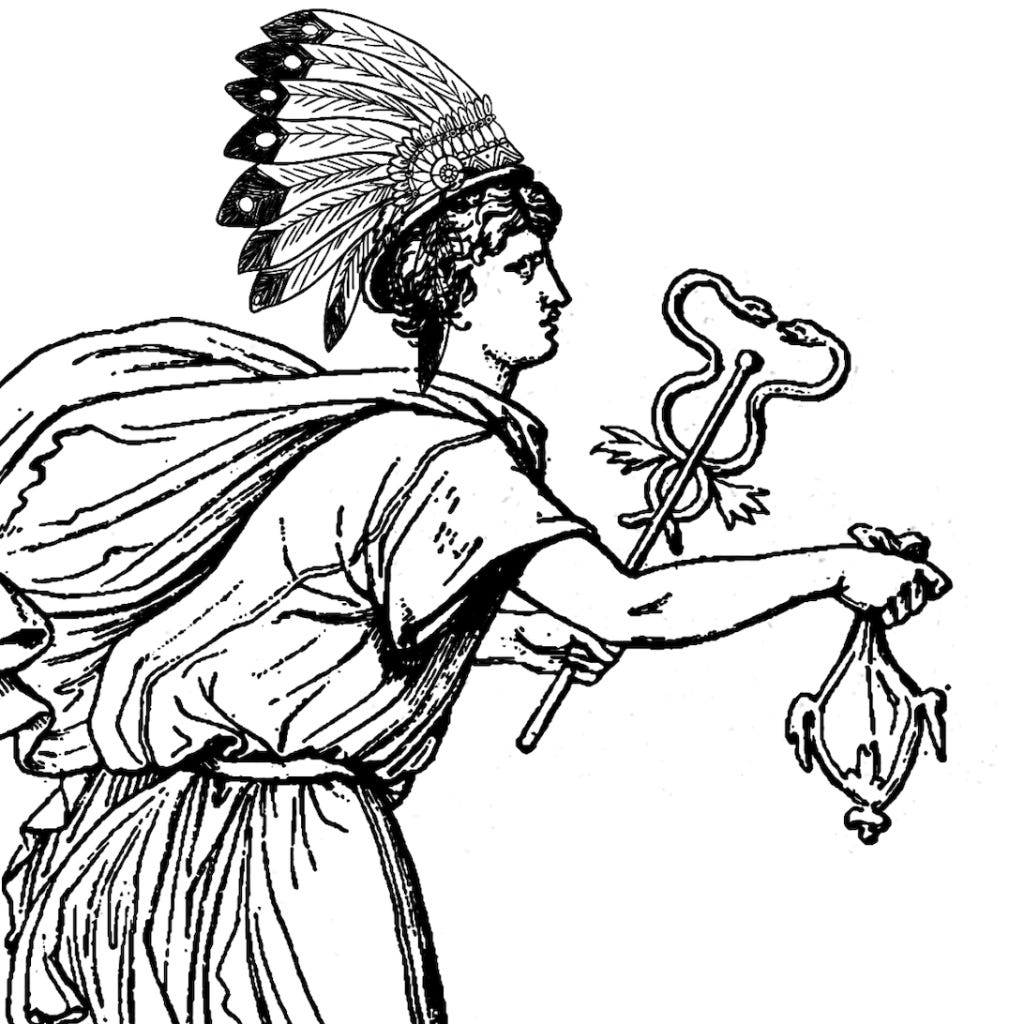
Although written from a character’s point of view, Ramsay frequently alludes to studying the sacred books of Hermes. He understands how there were records of many versions of Hermes and the divine sciences they penetrated. He calls Trismegistus the “restorer of the ancient religion.” He also references Plato’s narrative of an Egyptian priest telling Greeks they are always children, knowing nothing of the ancient world.
“I had read the books of Hermes, knew his whole doctrine about the mysteries of nature, and had been instructed in the occult sciences. We apply’d ourselves to study those wonders by experiments; to descend from known effects to those which are more hid, and to reascend from thence to first causes. When we had examined, compounded and dissolved bodies of all kinds that are found in those subterraneous regions, we at last discovered that in the visible universe there were but two principles, the one active, the other passive ; an elementary fire, uniform, universal, and infinitely subtile, and an original virgin earth which is hard, solid, and the substance of all bodies.” (76-77)
Pythagoras
“The greater Pythagoras, proved the author of the 47th problem of Euclid’s first book, which, if duly observed, is the foundation of all Masonry, sacred, civil, and military.” - James Anderson. 1723. The New Book of Constitutions of the Antient and Honourable Fraternity of Free and Accepted Masons
Andrew Micheal Ramsay - The Travels of Cyrus (1727)
“I had read the books of Hermes, knew his whole doctrine about the mysteries of nature, and had been instructed in the occult sciences. We apply’d ourselves to study those wonders by experiments; to descend from known effects to those which are more hid, and to reascend from thence to first causes. When we had examined, compounded and dissolved bodies of all kinds that are found in those subterraneous regions, we at last discovered that in the visible universe there were but two principles, the one active, the other passive ; an elementary fire, uniform, universal, and infinitely subtile, and an original virgin earth which is hard, solid, and the substance of all bodies.” (76-77)
“The most famous of these Pyramids was that of Hermes. It was of polished Stone, and its Height more than Six hundred Feet. Neither Winds nor Earthquakes could injure it.” (160)
The
“first Hermes, a divine Youth, who was beautiful without knowing it, had Wit without thinking so, and who was unacquainted with his own Virtue, because he was ignorant that there were Vices,”
and this Hermes
“penetrated into all the Secrets of Nature, and of Divinity. It was the Age of occult Sciences. The Greeks, said the Egyptians, imagine that the World in its Infancy was ignorant; but they think so, only because they themselves are Children. They know nothing of the Origin of the World, its Antiquity, and the Revolutions which have happen’d in it. The Men of Mercury’s Time had yet Remembrance of their first State, and had diverse traditional Lights which we have lost. The Arts of Imitation, of Poesy, Musick, Painting, every thing with the Province of the Imagination are but Sports of the Mind, in Comparison of the sublime Sciences known by the first Men.”
Sources for Further Study
The Regius Poem and The Cooke Manuscript — early English Old Charges and legendary histories of the Craft. Josephus, Antiquities of the Jews, Book I, chapter 2 — the tradition of the pillars preserving antediluvian knowledge. Clement of Alexandria, Stromata — a Christian version of the two-pillar tradition. Isidore of Seville, Etymologies — medieval accounts of Mercury, language, music, and Hermes Trismegistus. James Anderson, The Constitutions of the Free-Masons (1723; expanded edition 1738). Andrew Michael Ramsay, The Travels of Cyrus (1727) and the Masonic Oration (1736–37). The Diary of Elias Ashmole, ed. C. H. Josten (1966). Henrik Bogdan, Western Esotericism and Rituals of Initiation (2007). David Stevenson, The Origins of Freemasonry: Scotland’s Century, 1590–1710 (1988). Collin Conkwright, “Hermes in Freemasonry: An Investigation of Masonic Myth-Making” (2026) — useful modern synthesis and guide to the source trail.
Library of Light Edition 1.0 — Last revised: September 2026