“Rebis is two things, and these two things are one thing, namely, water joined to a body, by which the body is dissolved into a spirit, that is, mineral water, out of which it was first made; and this body and spirit make up one mineral water, which is called Elixir, that is to say, ferment; for then water and spirit are one thing, of which is composed a tincture and medicine for purging all bodies.”\
- Anonymous, The Golden Tract Concerning The Stone of the Philosophers (attributed; wording and edition need verification).
Res bina — The Union of the King and Queen
The combined power of the King and Queen is embodied in Rebis: the twofold being in whom the divided powers of the Work become one nature. From the Latin res bina, “two things,” “dual thing,” or “twofold matter,” Rebis names the union of opposites and the substance born from their reconciliation. The Divine Androgyne gives this mystery a human form: one body bearing male and female heads, the Sun and Moon united without losing their distinction. As an image of the Philosopher’s Stone, Rebis expresses the culmination of the Great Work. As the child of the conjunction, it also signifies a new beginning: the unified matter that must be nourished, perfected, and brought into stable manifestation. The marriage, its offspring, and the completed Stone are closely related images, but need not designate an identical moment in every alchemical account.
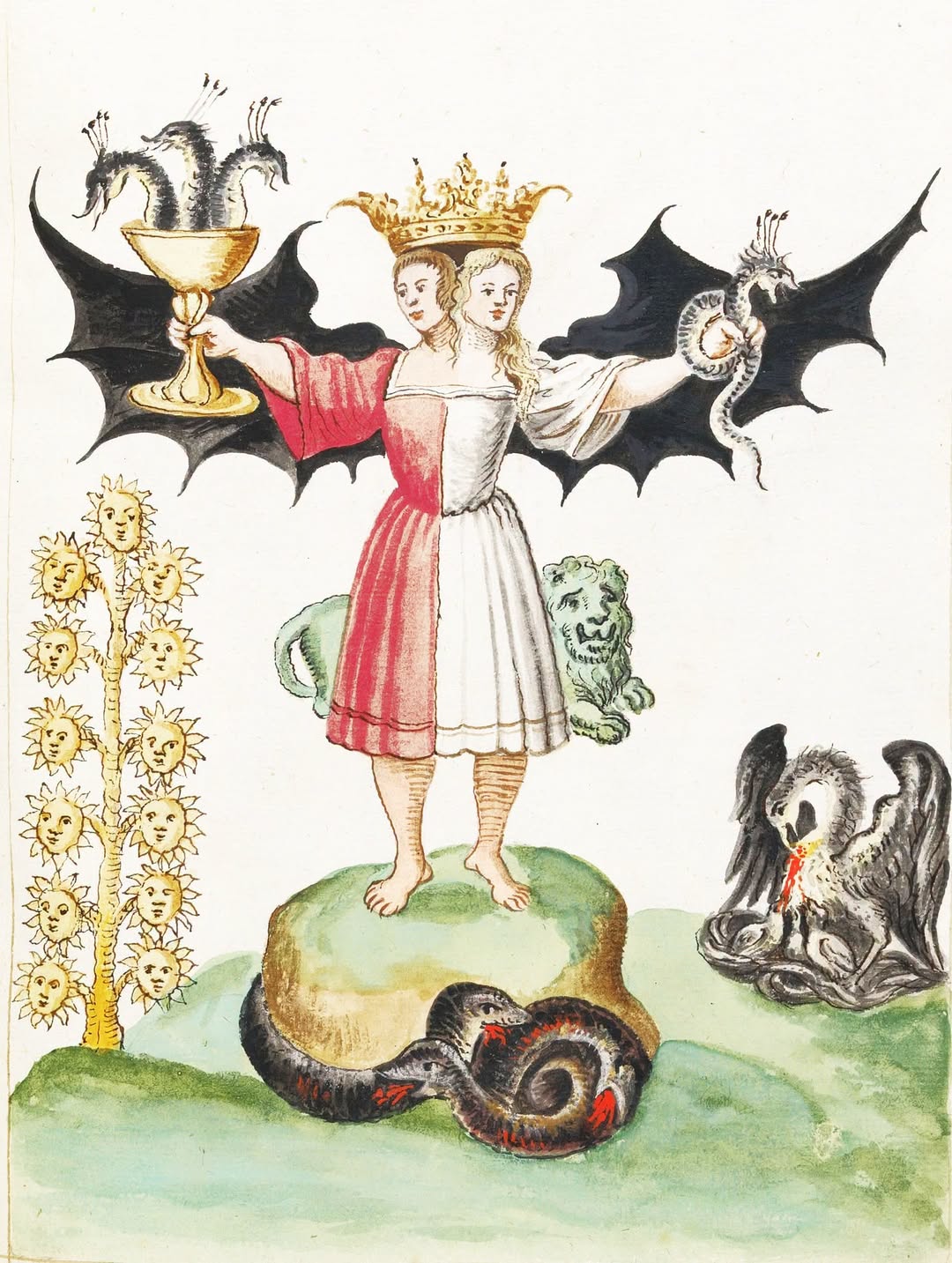
The Union of the King and Queen
The Red King and White Queen are Sol and Luna, sulfur and mercury: the solar and lunar powers through which the Work is accomplished. Their marriage is the coniunctio, the conjunction or Chemical Wedding. Rebis is their union embodied, not merely the two figures standing beside one another. The traditional phrase compositum de compositis—“conjunction of compounds,” or a composite of compounded things—points toward a union of natures already worked upon. Decomposition and purification first disclose and separate what was confused; conjunction reunites the opposing qualities in a transformed condition. Spirit and matter are reconciled rather than one being discarded for the other. The polarities gathered into this image include male and female, sulfur and mercury, light and darkness, day and night, Sun and Moon, King and Queen, active and passive, hot and cold, dryness and humidity. These are related symbolic languages, not interchangeable descriptions in every context. Together they express the central task: the powers that appeared divided must become capable of acting as one.
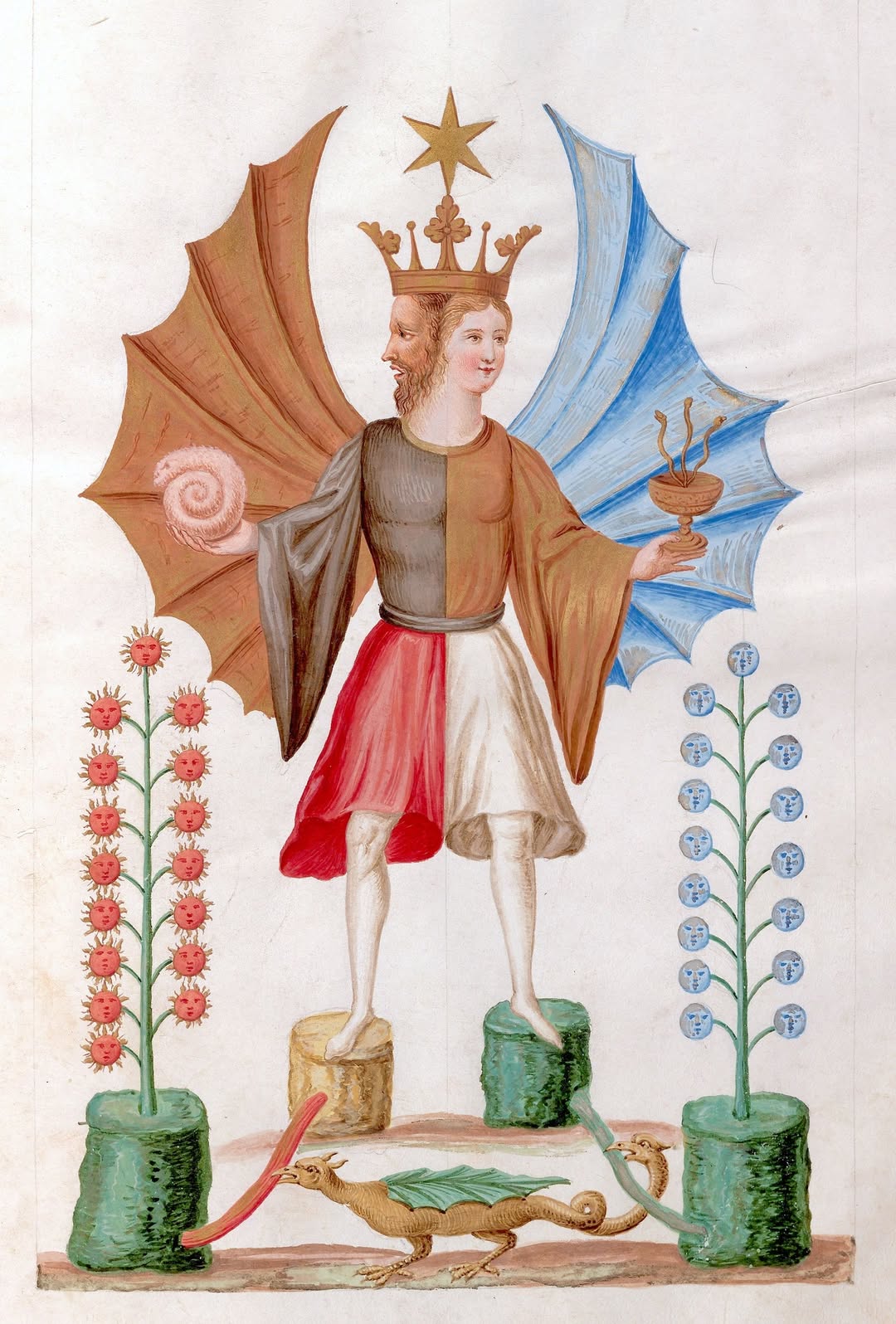
The Divine Hermaphrodite or androgyne is therefore simultaneously one and two. The two heads sharing a single body signify a unity that retains distinction: the Red King and White Queen remain recognizable, but their life and action belong to one being. “Hermaphrodite” is used here in its historical alchemical sense, as the emblem of a double nature.
Separation, Conjunction, and the Birth of the Stone
The opening passage from the Golden Tract expresses the mystery through the language of substance and operation: water joins a body, the body is dissolved into spirit, and body and spirit become one mineral water. The result is called Elixir, ferment, tincture, and medicine. Rebis belongs not only to an image of spiritual wholeness but also to the alchemist’s account of the transformation of bodies. The movement is from decomposition and purification to reunion, from reunion to the birth of a new nature, and from that birth to its perfection. In the sequence used here, the blackening (Nigredo), whitening (Albedo), and yellowing (Citrinitas) prepare the conjunction’s fulfillment in the reddening (Rubedo). This is a symbolic ordering rather than a fixed historical timetable shared by every text. Rebis may thus be contemplated as the living Philosopher’s Stone before its full manifestation: the philosophical child in whom the opposing principles have become one, yet whose nature must still be fixed, matured, and multiplied. The union is both an attainment and the condition of further Work.
Rebis in Michael Maier’s Atalanta Fugiens
Michael Maier’s Emblem XXXVIII presents Rebis through Hermaphroditus and the two mountains of Mercury and Venus. The 1618 engraving preserves the same central theme: a double nature brought forth as one being. The supplied English rendering is retained below; its precise translation should be checked against the edition used. [1]
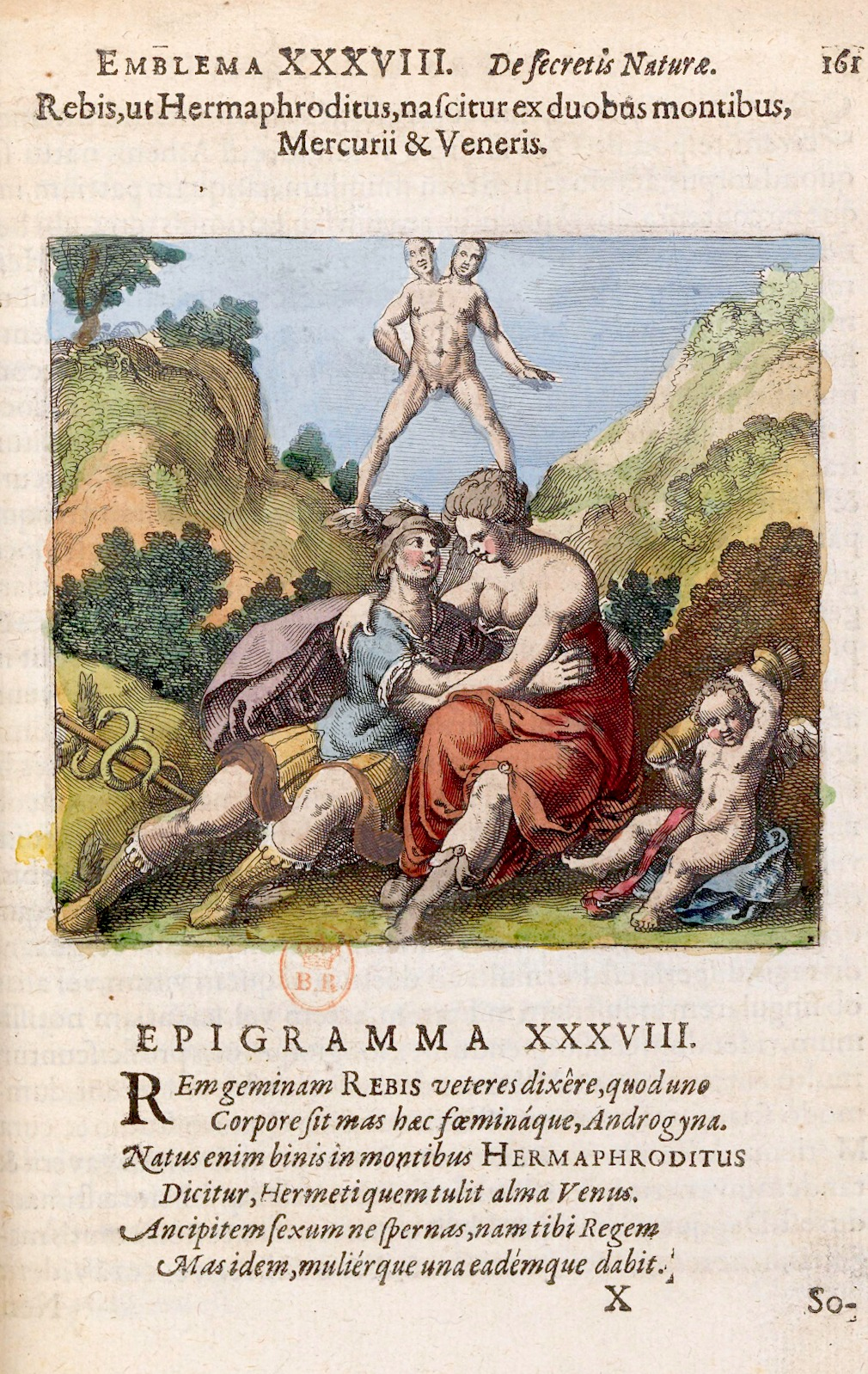
EMBLEM XXXVIII. On the Secrets of Nature. Rebis, like Hermaphroditus, is born from two mountains, Mercury and Venus. Epigram XXXVIII: The ancients called Rebis twin-born because in one body are both male and female—an androgynous being. For from two mountains was Hermaphroditus born, So is it called, given by Hermes and gracious Venus. Atalanta fugiens, hoc est Emblemata nova de secretis naturae chymica, by Michel Maier (1568-1622)
The mythic parentage—Hermes and Venus—joins alchemical language to classical myth. Here the two mountains belong to Maier’s particular formulation; they should not simply be substituted for the sulfur–mercury pair in every other emblem. What remains constant is the birth of a single nature from a dual origin.
Splendor Solis: The Rebis with Egg and Mirror
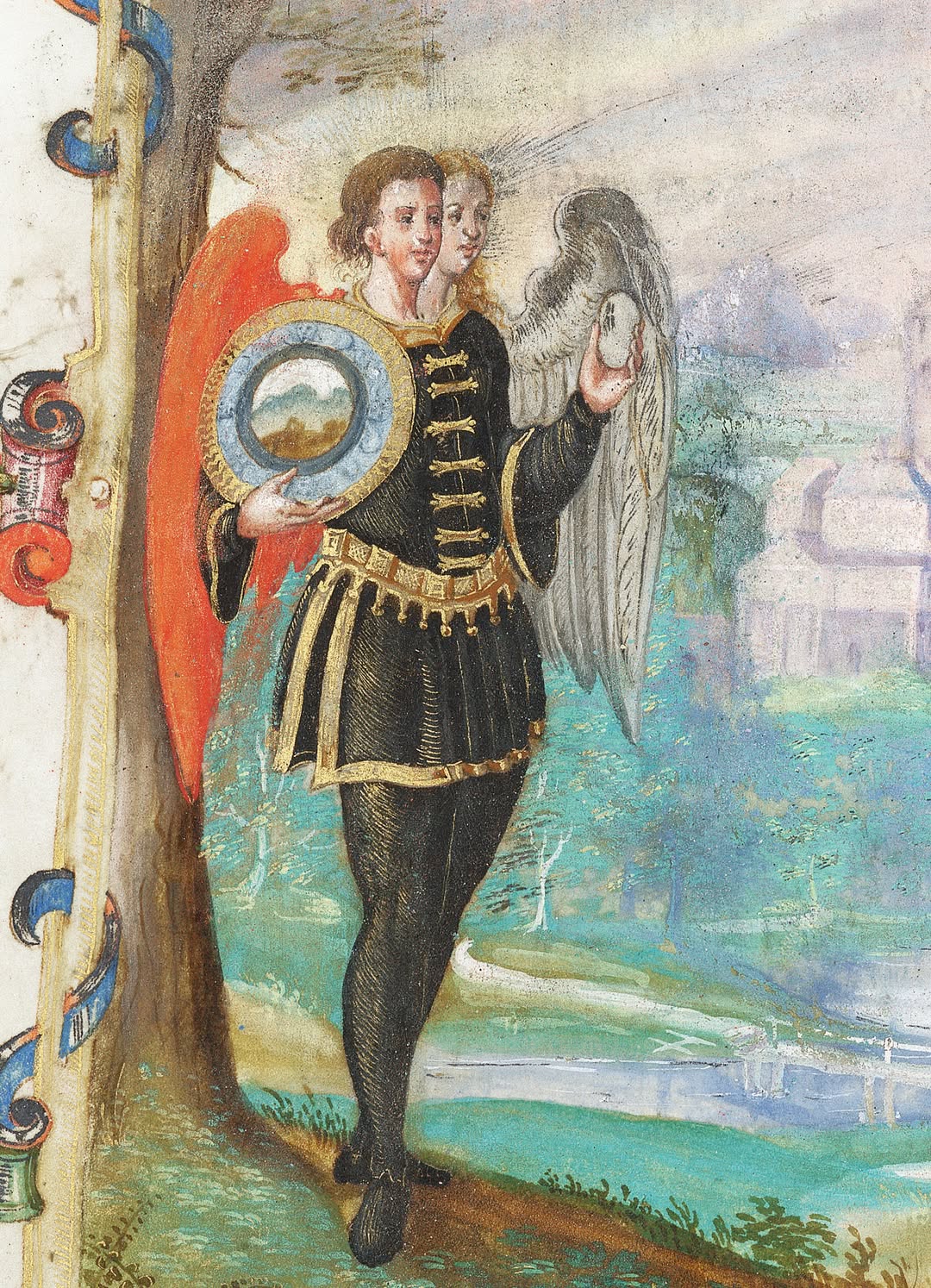
The winged androgyne belongs to Plate IX, the fifth of the seven parables in the 22-image sequence of Splendor Solis. In that sequence it follows the resurrection from the swamp and precedes the severing of the King’s head. Its position is important: the image can express conjunction and rebirth without implying that every subsequent operation has already been completed. The same sequence is represented in the British Library’s Harley MS 3469; the precise manuscript origin of the image reproduced here remains to be confirmed. [2]
The Rebis holds the Philosophers’ Egg and a mirror or reflective shield. The egg gathers the elements into a single potential life; the mirror introduces reflection, clarity, and the relation between the little world and the greater world. The red and pale wings bring the solar and lunar powers into one figure. Together these features present the sacred union of male and female, Sun and Moon, giving birth to perfection in the Great Work.
"A hermaphrodite, winged, standing on a globe representing the world, with one wing red and the other white, holding in the left hand an egg, and in the right a round mirror or shield. This figure signifies the union of the male and female principles, the rebirth of the matter after putrefaction, and the emergence of the four elements from the perfected substance. United pairs of opposites bring forth the children of nature: earth, water, air, and fire."\
- from Splendor Solis (attributed).
The wording above is preserved from the existing page. Needs source — please verify the passage’s edition and translator, including its description of a globe and the placement of the egg and mirror. The accompanying notes assign the objects to the opposite hands; that discrepancy remains unresolved. The quoted description should not yet be treated as a verified translation of the original text.
Lux Lucens in Tenebris — The Angel of Light
Lux lucens in tenebris—the light that appears within darkness. Angelus Lucis—the Angel of Light. These names introduce the contemplative reading preserved below; they are not established here as the manuscript’s original title for the plate. The following reflections interpret the image through the inner Work. Statements about consciousness, angelic intelligence, the meaning of the landscape, and the adept’s attainment are symbolic readings rather than verified claims about the historical painter’s intention. References to a sphere at the heart, two heads, or two angels should likewise be read as broader Rebis symbolism where they do not match this particular image.
The figure is androgynous and double-faced - a single being that contains a dual nature within one body This is Mercurius in his perfected or mediating form: neither purely spiritual nor purely material, neither masculine nor feminine, but the reconciler of opposites. The double face indicates simultaneous vision into two worlds, or two stages of the Work at once.
The wings confirm that this is a spiritual or subtle principle rather than a human individual. One wing is red, the other pale or grey. Red corresponds to the rubedo, the stage of completion, incarnation, and life-force. Pale or grey corresponds to the earlier whitening and to the realm of spirit. The figure stands between these conditions rather than exclusively in one.
In the left hand is a circular vessel or disk, often interpreted as a mirror, plate, or shallow bowl. It reflects a landscape. This is not a literal object but a symbol of the world reflected in consciousness. It holds a highly reflective circular shield or mirror, symbolising self-knowledge, clarity, or the reflective nature of the perfected matter.
In the right hand is an egg. This is the Philosophers’ Egg: the sealed vessel of transformation, the womb of the Stone, the microcosm containing all elements in potential. Holding the egg openly means that the Work has progressed beyond chaos and concealment. The operator now knows what the vessel is and how it functions.
The figure stands outdoors, not in a laboratory. This is important. Splendor Solis repeatedly shows that the true Work ultimately unfolds in life itself, not only in glassware.
The Hermaphrodite or Rebis—the unified being that emerges after the conjunction of opposites in the alchemical work. It represents the stage following the Chemical Wedding, where Sol and Luna (sulphur and mercury, king and queen, masculine and feminine) have been joined and purified into a single perfected nature. The two heads sharing one body show this is not mere mixture but true union—two consciousnesses or principles integrated while retaining their distinct identities. The Rebis is simultaneously one and two, transcending duality without erasing it. The sphere held at the heart contains the microcosmic world or the Stone in formation—the fruit of the union. This is the philosophical child, the new being that could not exist until the opposites were reconciled. The red and white wings flanking the figure represent the sulphurous (red, active, solar) and mercurial (white, receptive, lunar) streams that have now been embodied. They are no longer separate forces but attendant powers of the unified adept. Their presence suggests this union is both protected and witnessed by angelic intelligence. In the sequence of the Great Work, this follows the blackening (nigredo), whitening (albedo), and yellowing (citrinitas), and precedes or coincides with the reddening (rubedo)—the final stage. The Rebis is the living philosopher's stone before its full manifestation, the integrated self that can now perform the final fixation and multiplication. The practical meaning: the adept has reconciled inner opposites—spirit and body, intellect and intuition, will and surrender—and now operates from wholeness rather than conflict. The two angels are no longer warring but serving. This is the stage where the initiate becomes capable of the Magnum Opus in the outer world because the inner Work has achieved stable synthesis.
The Crowned Rebis: Sun Tree and Moon Tree
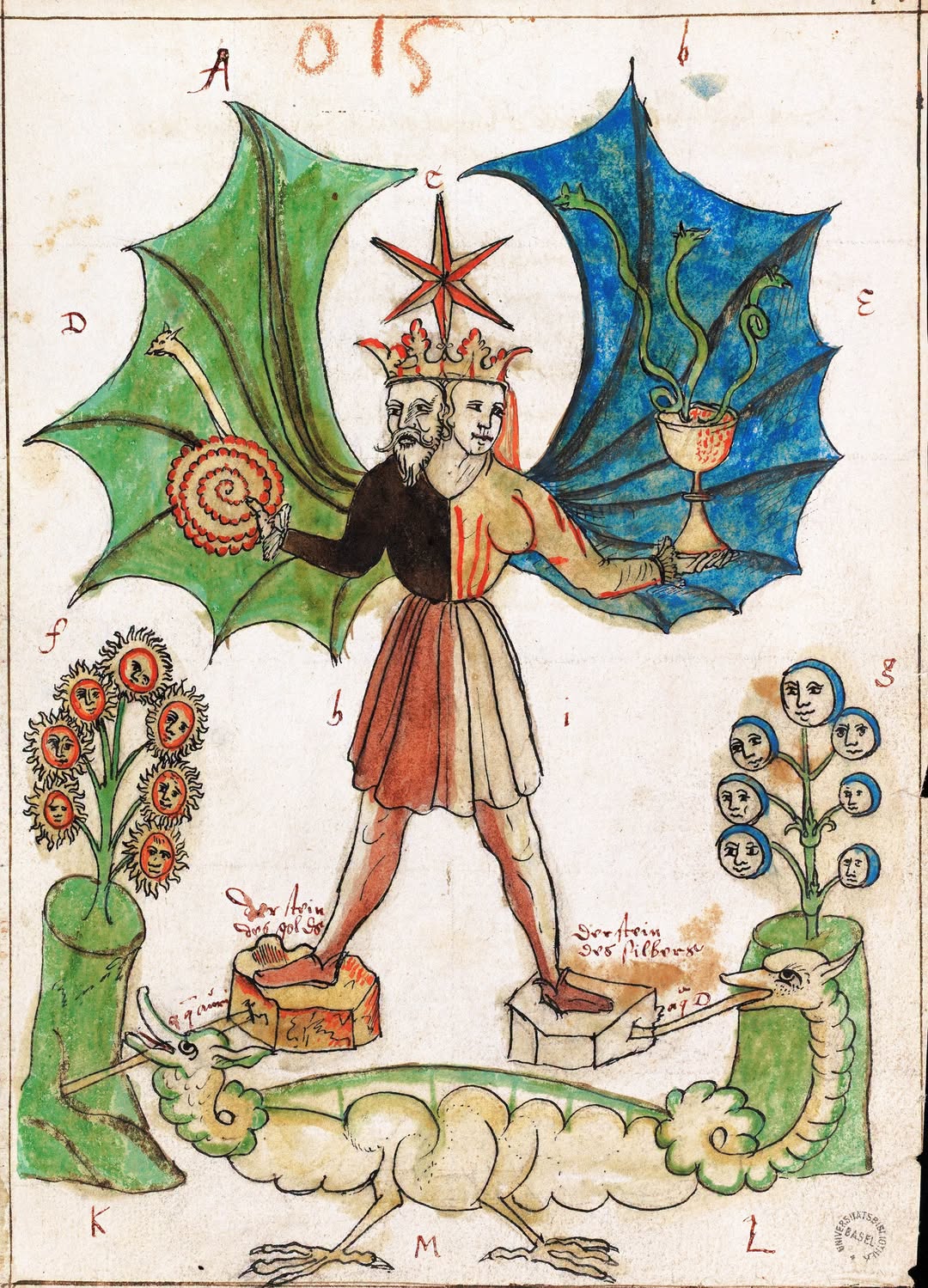
The accompanying legend to the Basel image extends the same union through wings, garments, mountains, trees, serpents, a dragon, a star, and a Crown. The solar and lunar powers are not isolated signs: they participate in one living process. The chalice offers life; the dragon consumes the flowers of Sun and Moon; red and white bring the Art to its end. The full supplied English legend is preserved below. Its translation and manuscript reference need verification.
"A: The wing of the green lion lifts itself into the air. B: The wing of the moon illuminates the beautiful night. C: The star signifies the perfection of the stone, exalted by the crown. D: The dragon signifies the transformation E: The chalice of life from which the snakes drink, through the living gold. F: The tree of the sun brings joy and bliss. G: The tree of the moon is the seed of the sun. H: Through the red garment, the art shall be made ready. I: Through the white garment, the art is completely ready. K: The mountain out of which the sun tree grows. L: The mountain of the moon illuminates the beautiful night. M: The dragon consumes the two flowers, of the moon and of the sun, for it is a proper food. Through red and white, the art is brought to an end, as the philosophers have intended."\
- Alchemistische Sammlung, c. 1550, Universitätsbibliothek Basel (supplied English rendering).
The Work Embodied
Across these images, the King and Queen, the philosophical child, the winged androgyne, and the crowned double being express different aspects of one subject. What is separated is purified; what is purified is joined; what is joined becomes capable of a new life. The Rebis embodies the reconciliation of polarities leading to wholeness and illumination. The same theme appears in The Chemical Choir, where fire and water are contemplated through their conjunction in the hexagram. Here the union takes the form of a living being. In the inner reading of the Royal Art, its practical meaning is the reconciliation of spirit and body, intellect and intuition, will and surrender: the adept acts from an integrated nature, and the inner Work becomes capable of expression in life. [3]
Library of Light Edition 1.0 — Last revised: @October 29, 2026